
How the Transatlantic Cracks Transcend Trump
And why investors should pay attention now

If you got lost in last week’s headlines about Israel’s attack on the South Pars gas field, gyrating commodities prices and President Donald Trump’s unseemly reference to Pearl Harbor while sitting next to the Japanese prime minister, you may have overlooked the much more consequential news. America’s closest allies refused a direct request for help in a live military operation. “Because we have had such Military Success, we no longer ‘need,’ or desire, the NATO Countries’ assistance — WE NEVER DID!” was the president’s initial reaction on Truth Social. On Friday, he called them “COWARDS,” yes, in all caps.
Set aside, for a moment, the president’s exuberant style. Set aside the fact that he launched the attack on Iran without consulting European leaders. Set aside unilateral tariffs, J.D. Vance in Munich and the aborted land grab in Greenland. The worsening cracks in the transatlantic alliance may transcend even this voluble president, and there will be consequences for any investment strategy that depends on the world’s most important economic relationship.
America’s ties to Europe have never been entirely smooth. Since George Washington’s 1796 warnings about “foreign entanglements,” Americans have found European politics baffling and dangerous. It wasn’t until that very same Japanese attack that the United States felt compelled to enter Europe’s war against the Nazis. From the Suez Crisis to the Iraq War, the NATO alliance has survived repeated strains.
Still, there are important new forces afoot today. Above all, America is simply growing less European. The White population, mainly of European descent, has dropped from 85% in 1970 to roughly 60% today. In the 1960s, some 75% of all immigrants were Europeans, compared to 10% today.
Second, differences in each side’s approach to global affairs have rarely been clearer. Europeans, with their much longer history, tend to view international threats as risks to be managed, while impatient Americans see problems that must be solved. Even if Europe had a coherent military force at its disposal, its leaders are more attuned to the risks of eliminating one threat in a way that doesn’t create a dozen more.
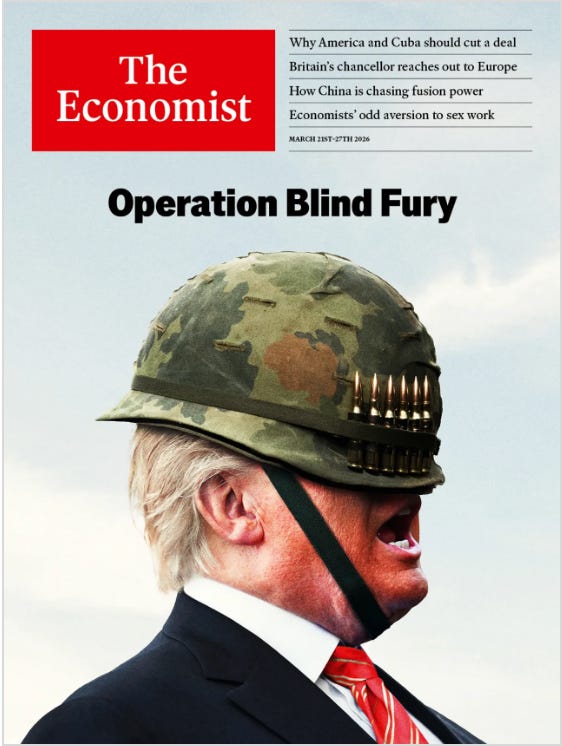
Third, popular sentiment about the trans-Atlantic partnership has plummeted on both sides. There are plenty of polls to cite about European views of America these days, but few pictures sum them up better than this week’s Economist cover (above). More importantly, Americans don’t necessarily see European security as relevant to their own. A recent YouGov poll reported just 54% saying they care about the outcome of the Ukraine War, which is what gives Trump the scope to equivocate in his conversations with Russia’s Vladimir Putin.
In his anger last week, the president even went so far as to say he would consider pulling out of NATO, although that seems a stretch even for him. Despite Trump’s bravado, French, Greek, Italian and other forces are already helping indirectly in the defense of Gulf states, and Europe has pledged $458 million in humanitarian assistance. If the Strait of Hormuz is cleared of most Iranian risks, he will need Europeans to help supplement U.S. Navy escorts.
But the rifts in the relationship risk growing larger and deeper beyond this conflict. Even a more traditional, internationalist president after Trump will have trouble unilaterally repealing tariffs on Europe or making major new commitments to NATO. Views on the Middle East, Latin America and China will all be harder to align.
Just what this means for corporate managers or investors is difficult to know precisely, but they should at least brace for a much bumpier ride. No, global investors won’t abandon the dollar in favor of the euro, because European capital markets are not nearly as deep or sophisticated. No, Europeans and Americans will not stop visiting each other’s countries. Europeans won’t boycott Hollywood films any more than Americans will abandon French wine and German cars.
But the rifts in the relationship risk growing larger and deeper beyond this conflict.
But Europe is acting. Slowly, but surely, it’s building out its own defense capabilities, especially in Germany. The expansion of joint debt issuance, which will soon reach € 1.1 trillion, will reinforce European Union institutions. More likely than not, distrust of America, even under a new president, and fear of Russia, even after a peace with Ukraine, will embolden European leaders to act more decisively.
For the U.S.-Europe relationship, this means that resolving differences over trade, taxes, and sanctions will become more difficult. European voters wonder why their sovereign reserves hold so many U.S. Treasuries and push for more rapid diversification. And the next financial crisis will pose far greater risks if markets can no longer count on the U.S. Federal Reserve to offer quick, unconditional swap lines to European markets.
Sooner than we think, we may long for the days when the worst that could happen for trans-Atlantic commerce is a social media post in capital letters.
Insightful and forward looking as always!