
Not Everyone Loves a Parade!
This weekend’s festivities in Moscow underscore how the Iran War has made things worse for Russia rather than better.

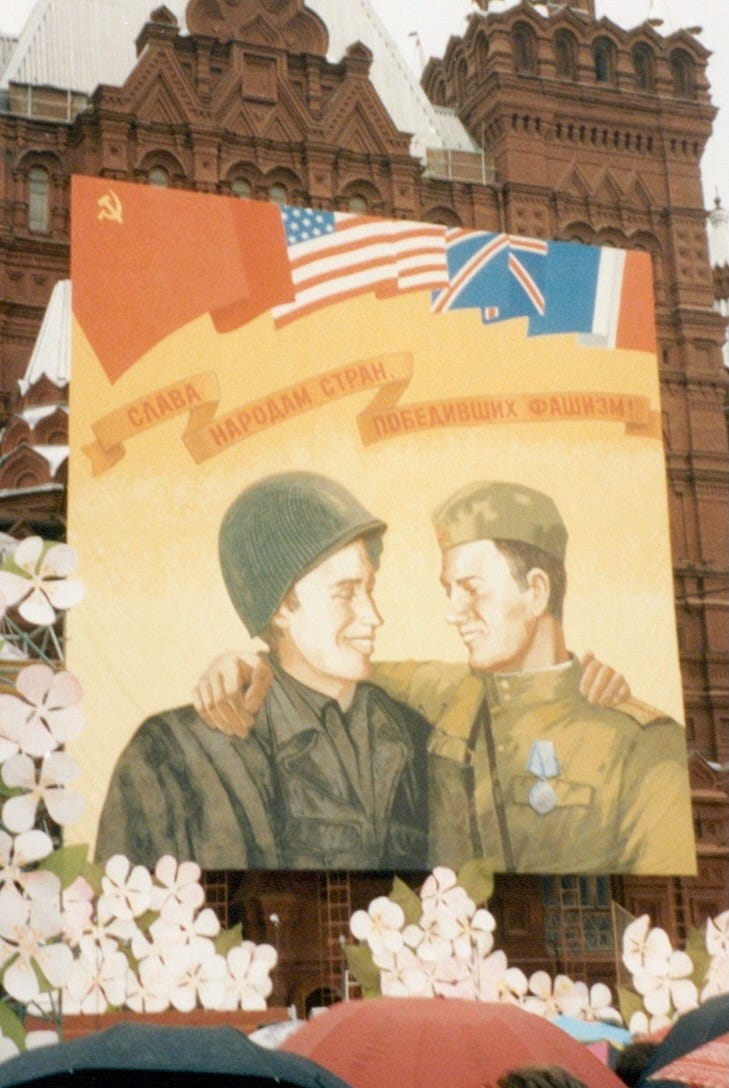
In November 1941, with German forces some 50 miles from Moscow, Stalin ordered a showy parade through Red Square to commemorate the Bolshevik Revolution. Some troops were marched directly from the front to participate, while diplomats and foreign journalists were invited to bear witness to a country whose spirits could not be broken.
Some 31 years ago, my wife and I attended huge celebrations marking the 50th anniversary of Victory Day, which were more directed at confused citizens emerging from a shattered Soviet Union. The parade recalled the immense sacrifice of 27 million Soviet dead but also raised hopes of a new era of opening and reintegration with wartime allies. A giant Red Square poster showed a Russian soldier with his arm around a Western ally under the slogan: “Glory to the Peoples who Defeated Fascism!” British, American and French flags waved above them.
This weekend, Vladimir Putin’s Russia staged an understated, hurried march past Lenin’s Tomb with a message that was less defiant or triumphant. At just 45 minutes, it was half the length of last year’s parade, and the only visible military hardware was projected on giant video screens.
Ten weeks into the Iran War, the conventional wisdom argues that Putin’s Russia is an unintended winner, benefiting from sky-high oil prices, lax sanctions enforcement and a distracted America. (I may even have suggested as much in an argument I have now reconsidered.) Ironically, however, the oil spike has only exposed the weakness of the Russian economic engine. The Gulf turmoil has turned into an unexpected boon for Ukrainian diplomacy. And the war’s geopolitical shifts will only drive Putin into even deeper dependence on China’s President Xi Jinping.
Closing the Strait of Hormuz was, to be clear, a pleasant surprise for Russia’s finance ministry, which had ordered huge cuts in non-military spending for 2026. But Russia books an estimated $1.6 billion per month for every $10 increase in oil prices. Then there are taxes on higher natural gas, fertilizer and all the country’s other commodity exports. The problem is that Moscow’s budget masters understand all too well that these windfalls do nothing to change the fact that Russia’s near-term growth depends overwhelmingly on war spending.
In fact, last week, Russia’s Economic Development Ministry reported the first quarterly contraction in three years, as household income growth slowed dramatically. After two years of an economy supercharged by defense spending, consumer demand is running out of steam. Putin likes to brag about unemployment at 2.2%, but that’s mainly due to a severe labor shortage from so many men fighting and dying in Ukraine. While inflation near 6% is lower than last year’s, interest rates remain a whopping 14.5%.
The last few months, meanwhile, have been good for Ukrainian diplomats and soldiers. Zelensky concluded security agreements with Saudi Arabia, Qatar and the United Arab Emirates. They get crucial air defense technology and training now that their neighborhood has turned dangerous; Ukraine gets a fresh set of deep-pocketed backers beyond the United States and Europe.
On the battlefield, Russia’s spring offensive has yielded virtually no territorial gains, while it has been losing more troops in battle than it has been able to recruit during the first quarter. This may force Putin to consider expanding unpopular conscription even as his own popularity has dropped to a four-year low.
Finally, the prospect of a much longer war and a flagging economy only drives Russia into a deeper long-term dependency on China. In the short term, China has already boosted its purchases of Russian oil, gas and coal, and its latest five-year plan calls for progress on a new gas pipeline from Russia. But Beijing drove a hard bargain over the terms of its Power of Siberia 1 pipeline, and it surely recognizes just how desperate Russia may be to move ahead with a second project now that it has lost its Western markets.
Ironically, the oil spike has only exposed the weakness of the Russian economic engine.
And while Russia angles to offer Iran arms and intelligence support in its fight against America, Tehran will always prioritize its relationship with Beijing. China not only bought 80-90% of Iran’s oil exports but also kept the Iranian economy afloat through industrial imports and structural investments amid rigid Western sanctions.
A three-day ceasefire between Ukraine and Russia, announced on Friday by President Donald Trump, had already collapsed by Sunday as both sides accused the other of violating its terms. While Ukrainians have grown accustomed to Russia’s attacks over four years of fighting, Ukraine’s attacks on Russian territory have increasingly rattled Russia’s leaders.
Zelensky had issued a cheeky decree ordering Ukrainian forces to withhold any attacks on Saturday’s Victory Day Parade “on humanitarian grounds.” He then listed the precise geographic coordinates of Red Square.
In a revealing riposte, Russian officials denounced it as “a silly joke.”
Excellent analysis and outstanding knowledge of past and current Russia. Always something to learn!