Our Own Worst Enemy!
Americans now rank themselves (above North Korea!) as the country's top threat


Polls are polls are polls. But this one is a head-scratcher.
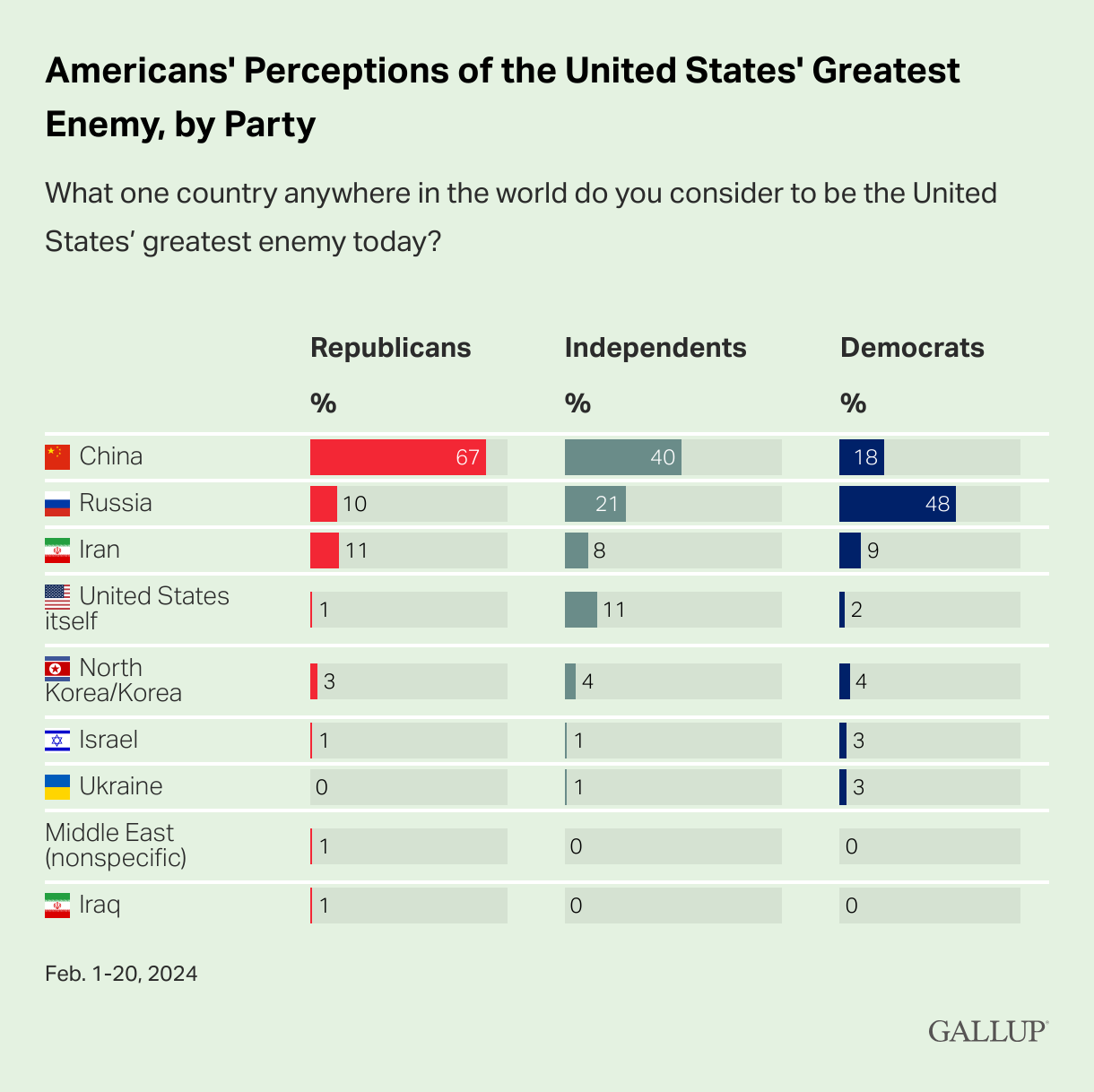
With U.S. unemployment still at 50-year lows and the S&P 500 setting record highs, there’s a surge in Americans who now rank the United States itself as their country’s “worst enemy.” China, of course, comes first, with Russia and Iran next. But for the first time since Gallup started asking the question in 2001, some 5% of those asked believe we are our own worst threat, ahead of the 4% who name North Korea.
The result was never more than 1% until this year.
There has been plenty of ink spilled about why Americans are so disgruntled, amid the warm glow of rising real wages, broad career opportunity and amazing technological progress. A separate Gallup survey out this week has the United States slipping to No. 23 (from No. 15 last year) among the happiest countries in the world, with Finland still firmly in first place.
Of course, there’s inflation. Sure, it’s statistically slowing, but that doesn’t help much when a lunch-counter sandwich costs $15 and we feel lucky to find a $3.50 gallon of gasoline. Then there are all the media channels who spotlight the tragedies, outrages and crises of the day. Yes, we would likely ignore a more balanced stream of reports that things are mostly fine, but the drumbeat of disaster surely doesn’t help the mood. Then there is the swirl of scientific breakthroughs that are both exciting and deeply unsettling. America is surely at the forefront in developing artificial intelligence, cyber security and biotechnology, but do we trust our leaders to manage them well?
Scratching at these numbers may offer a partial answer to what’s going on. In fact, just 1% of Republicans name the United States as their worst enemy and 2% of Democrats. But a whopping 11% of independents list the U.S. as the country’s worst threat, which makes it even more worrying to them than either Iran or North Korea.
Could it be that more partisan Americans, whether Republicans or Democrats, still believe in the system or at least hope their party has a good chance of prevailing on key issues? Do those who consider themselves less partisan focus more on a Congress that can’t pass a budget, a presidential candidate facing 88 felony charges and a sitting president who is among the least popular since World War II?
I have an unproven theory that 85% of Americans agree on 85% of the issues, but that fierce division around the edges freezes progress in the middle. While I still believe that to be true, it’s worth watching this poll question closely over the next few years. If the number of independents naming the U.S. as its own worst threat continues to surge, the “reasonable” middle may start to drop out of the process altogether. When that happens, compromise grows harder, court rulings look more partisan and debt dynamics turn wobbly.
A single poll hardly determines the country’s future, but this one gives pause.