
Deal or No Deal?
All those trade announcements give a false sense of certainty over future tariff levels, as we learned this week. Inflation expectations will continue to edge higher.


“Nothing is agreed until everything is agreed.”
This is the motto of all savvy trade negotiators, because they understand better than most that economic relationships among countries involve hundreds of political, social and commercial interests that need to weigh in before any binding agreement can be inked. And while general principles work fine for the press conference, the details really matter for the folks who are buying and selling goods across borders.
So it comes as no surprise that the deal between the United States and the United Kingdom, announced with great fanfare in May, has now stalled. Some progress seems visible on pharmaceuticals, but steel has been difficult. This week, U.S. negotiators have paused conversations on joint technology development over what they see as British intransigence concerning on-line safety rules, digital services taxes and food safety restrictions.
None of this, in itself, should be cause for alarm, as these are complicated issues, even without all the interest groups jostling to be heard. Negotiations on legally binding trade agreements take an average of 18 months. The problem now is that the Trump administration has announced similar “frameworks” with the European Union, Japan, Vietnam, the Philippines, South Korea, Indonesia, El Salvador, Switzerland, Argentina, Malaysia, Cambodia, Guatemala, Ecuador and Liechtenstein. For some, there is more detail; for others, less. But none of these announcements offers certainty about which tariffs will apply to which goods. Any business with a customer or a supplier in one of these countries is left to guess about next year’s trading costs.
Then there’s the uncertainty from a looming Supreme Court decision on tariffs, the potential for new drama with China, the sectoral tariffs on steel and aluminum, and the administration musing about exiting the U.S.-Mexico-Canada trade agreement altogether.
All of which brings us to inflation and interest rates.
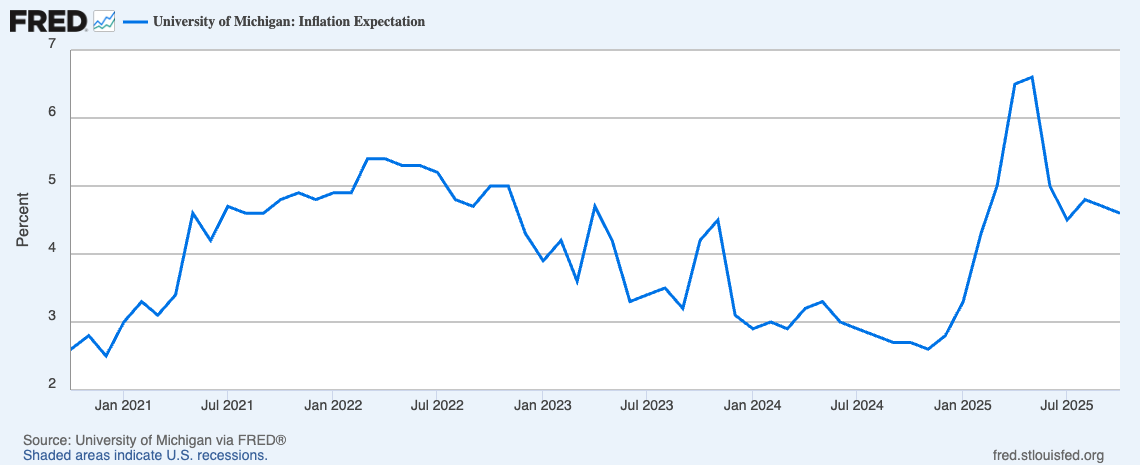
Team Trump is correct that tariffs are one-off price adjustments that should not fuel persistent price rises. What they fail to acknowledge are the twists and turns still ahead for U.S. trade policy, which has an extended effect on inflation expectations. Headline inflation is now below 3%, although we get a fresh update tomorrow.
The real problem, however, is that surveys show that inflation expectations over the next 12 months are still hovering near 4.5%. That should give the Federal Open Market Committee good reason to pause its latest cycle of rate cuts — at least until there is more clarity on America’s headline tariff rates.
To your point about deals not really being deals until the concrete details of those deals are decided and agreed upon, these announced deals are not so much deals as they are representations of deals for public consumption. While it might sound a bit hifalutin and impossibly French for a newsletter focused on trade and finance in the so-called real world, “être” has been completely swallowed by “paraître” in the full blown kayfabe world of our reality TV president. My persistent question remains: what happens when true reality intrudes into the pretend version? A settling of accounts seems inevitable in that sense. Or am I dreaming?
Very good points, and I agree across the board with no "ifs" or "buts". What amuses me is the fact that when it comes to inflation expectations, the Fed seems to live in a different universe. You and I see inflation expectations as a source of concern; Powell insists that they are well-anchored and a source of comfort. Go figure.